What caliche is
In dry climates, rain soaks a short way into the soil and then evaporates, leaving dissolved minerals behind. Over thousands of years, calcium carbonate builds up and cements soil particles together into a hard layer. That layer is caliche. The University of Arizona’s guide to managing caliche describes how it can range from soft, chalky nodules to rock-hard layers that are difficult to dig through.
Soil scientists call a strongly cemented layer a duripan or petrocalcic horizon. The USDA’s official description of the Suncity soil series, one of the soils mapped in the area, describes a shallow soil over a cemented duripan, and similar shallow, cemented soils are mapped across parts of Peoria and the West Valley.
What collapsible soil is
Collapsible soils are a separate issue. They form when wind or flash floods deposit loose silt and sand that dry out before they’re ever compacted. The particles are held in an open structure by small amounts of clay or salts. When water arrives, those bonds weaken and the structure collapses, so the soil loses volume, sometimes suddenly. The Arizona Geological Survey calls this hydrocompaction and lists collapsing soils among Arizona’s problem soils.
How caliche and collapsible soils affect foundations
Thin soil over a hard layer
When a slab sits on a thin layer of soil over caliche, the caliche itself is usually stable. The problem is the soil above it. If water concentrates in one spot, from a leak, irrigation or ponding storm water, the thin soil there can soften or collapse while the rest of the slab stays supported. That produces the classic one-corner settlement.
Water perched on caliche
Caliche can slow water from draining downward, so water can sit on top of it longer than it would in deeper soil. That keeps the soil above it wet, which is the condition that leads to collapse and settlement.
Clay pockets
Some West Valley lots also include clay, which can swell when wet and shrink when dry. Not every lot has it, and despite what you’ll read online, Peoria isn’t “all expansive clay.” Conditions vary lot by lot, which is why measurements beat assumptions.
What this means for repairs
Pier depth
Caliche can be good news for a pier, because firm bearing may be close to the surface. It can also be a challenge, because a pier can stop on a thin caliche lens that isn’t actually competent bearing. Helical piers can refuse early in caliche, so installation torque and site conditions guide the layout. That’s why pier depth is never assumed.
Drilling and excavation
Hard caliche slows digging and drilling, which affects how long a job takes. Crews plan for it.
Drainage matters even more
Because collapsible soils react to water, keeping water away from the foundation is the most effective long-term protection. Our drainage and soil stabilization work focuses on exactly that.
How to find out what’s under your home
You can look up mapped soils for any address using the USDA’s Web Soil Survey. It shows soil series and general properties for an area, though it can’t tell you about fill placed during construction or conditions under a specific slab. For that, an on-site evaluation and, for structural repairs, an engineer’s input are needed.
Caliche in Peoria neighborhoods
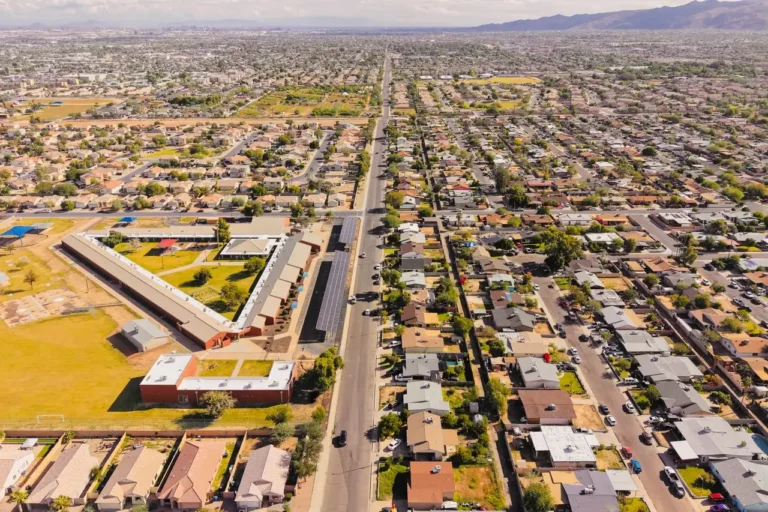
Shallow, rocky soils are especially common in north Peoria’s foothills, on the way to Lake Pleasant Regional Park, where graded lots often combine cut native ground with placed fill. In older parts of the city, decades of irrigation have changed how soils behave around homes. In both cases, water is the trigger.
Related reading
Leaks are one of the most common ways water reaches these soils; see our post on pool and irrigation leaks. And for the larger-scale ground movement tied to groundwater pumping, read our guide to earth fissures and land subsidence in the West Valley.
Caliche and collapsible soil FAQs
Is caliche bad for my foundation?
Caliche itself is usually stable and can even provide firm bearing for piers. The problem is the thin, sometimes loose soil above it, which can soften or collapse when water concentrates in one spot. Caliche can also slow drainage, keeping that soil wet longer. Good drainage and prompt leak repair are the best protection.
How do I know if my home sits on collapsible soil?
You can check mapped soils for your area on the USDA Web Soil Survey, but it can’t show fill placed during construction or conditions under a specific slab. Settlement that appears where water concentrates, such as near a leak or downspout, is a common sign. An on-site evaluation helps confirm the cause.
Is Peoria built on expansive clay?
Not entirely. Many soils mapped around Peoria are shallow soils over caliche with low shrink-swell potential, though some lots include clay pockets that can swell when wet. Collapsible soils and concentrated water cause much of the settlement we see. Conditions vary by lot, so measurements matter more than generalizations.